 |
| Maintain the curvature of the spine, don't hang the head off of the neck. |
Thursday, July 7, 2016
Correct Way to Curl the Neck or, "Chin to Chest"

Tuesday, July 5, 2016
The 5 Spine Shapes in Pilates

There are 5 spine shapes the we work with and through in Pilates:
Tall (often called "flat")
Round
Extension
Side Bend
Twist
 All of the spine shapes work with an elongated spine. In Tall spine, think of your back against a flat surface, either lying on your back on the mat, or standing with your back against the pole on the Ped-o-Pull, or against a wall. In order to elongate your spine, pull your tailbone towards your heels. Be careful not to tuck the tailbone and curl the pelvis. You should feel your sacrum and tailbone flat against your surface (mat, pole, or wall) and your low back lengthening. Now draw your low abdominals into your body and back towards your low back. You should now be feeling more of your lower vertebra connecting with your surface. Next, scoop your abdominals so your belly hollows out by pulling your low abs into your spine and then trying to pull your navel up under your ribs. Now more of your lumbar vertebra should be connecting to your surface and you should feel a lengthening in your waist. Now "funnel" your ribs, which means to draw them together in the front and pull them down towards your waist. This activation lengthens and supports the mid spine. Keeping your ribs together, open your chest by pulling the shoulders away from each other like you are trying to touch the two
In Round spine, we continue the elongation of the spine but now we curl forward so that the crown of the head (if your neck were to continue out through the top of the head, it would be going out through the crown) and the tailbone are trying to connect. It is important to maintain the length of the spine with everything that you activated in Tall spine so that you don't collapse in the low back or hunch your shoulders.
 |
| Rolling Like a Ball |
 |
| Tree Front on the Reformer turned upside down on the mat and now called Balance Control |
In Extension spine we maintain a Tall spine in the low and mid back and arch the upper back.
 |
| Swan on the Ladder Barrel |
Here it is important that you keep the neck and head in alignment with the spine and don't over arch the neck. The low and mid back stay long, the abdominals are lifting up to the breast bone, the ribs stay together, and the muscles of the back engage to open the front of the body.
This is a photo of what NOT to do in spinal extension:

In this photo, the body is arching in the low back while the mid and upper spine are flat. She is not drawing her abdominals in and up to support the low back and lengthen the spine, rather she is collapsed into her low back. The muscles of the back which lift the spine, open the chest, and draw the shoulder blades back and down are not engaged, causing her to hang in her shoulders. Ouch! :(
In Side Bending spine, again we start with Tall spine and then we arc the spine to the side bending near the solar plexus or lower ribs. Make sure that your hips and shoulders stay in alignment not only hip to hip and shoulder to shoulder, but also in the same plane as if you are side bending between two panes of glass.
|
 |
Side Arm Series on the Reformer
Side Bend or Mermaid
With Twisting spine you want to think of spiraling up. As with all spine shapes, start with Tall spine, then rotate the ribcage working from the waist (not the shoulders). Continuously lengthen the spine up as you rotate.

Spine Twist
 Snake and Twist mount |
Monday, June 20, 2016
Avoiding or Reducing Wrist Pain
During a Pilates session, it is important to maintain proper hand/wrist alignment and muscle activation in the upper body and Powerhouse to prevent the risk of or reduce nerve disorders.
The nerves that run through the hand, wrist, elbow, and arm travel in their own tunnels, or channels. It is important to maintain proper alignment during movement so as to minimize stress or irritation to the nerves which may cause pain, muscle weakness, or numbness.

Always work to maintain a neutral wrist. This avoids stress in the wrist and helps to connect the hands and arms to the larger muscles of the back rather than the smaller muscles of the shoulder.


When bearing weight on the wrists, think of how we stand on our feet: distributing the weight evenly, lifting the arches, wrapping the inner thighs, hips in line with the knees and ankles, and engaging the Powerhouse. The same is true for bearing weight on the wrists. We want to distribute the weight evenly across the 5 first knuckles of the hand, lift the wrists, lengthen through the arms, "wrap" the arms/shoulder girdle (rotate the forearms in towards the body and the upper arms outwards away from the body and draw the shoulder blades into the ribs and down the back of the body), shoulders over the wrist, and engage the Powerhouse.


Always work to maintain a neutral wrist. This avoids stress in the wrist and helps to connect the hands and arms to the larger muscles of the back rather than the smaller muscles of the shoulder.

When bearing weight on the wrists, think of how we stand on our feet: distributing the weight evenly, lifting the arches, wrapping the inner thighs, hips in line with the knees and ankles, and engaging the Powerhouse. The same is true for bearing weight on the wrists. We want to distribute the weight evenly across the 5 first knuckles of the hand, lift the wrists, lengthen through the arms, "wrap" the arms/shoulder girdle (rotate the forearms in towards the body and the upper arms outwards away from the body and draw the shoulder blades into the ribs and down the back of the body), shoulders over the wrist, and engage the Powerhouse.

Saturday, June 18, 2016
How to Prevent, Stop, and Relieve Muscle Cramps
If you have been reading the blog, you will remember a post I did back in May called, "What Causes Muscle Cramps". Therein I shared a video link about Rod MacKinnon who has been studying muscle cramps and found that it is the nerve which causes muscle cramping, not the muscle, not dehydration, not electrolyte imbalance. The article shared that he had developed a supplement that could be taken to help reduce or eliminate muscle cramping by targeting the nerve, that they were in the process of testing the product and that it would be released in 2016.
I said I would keep and eye out and let you know when there was more info, ... and here it is!
I have not tried this product so I am not endorsing it in any way, simply passing on new information :)
This is a copy of their press release and below that is a link to more information and how to buy HOTSHOT.

For Immediate Release SCIENTIFIC BREAKTHROUGH IN SPORTS NUTRITION TO CHANGE THE GAME FOR MILLIONS OF ENDURANCE ATHLETES A Genius Solution and New Category in Sports Nutrition: Neuro Muscular Performance BOSTON, MA – June 2, 2016 – Exercise-associated muscle cramps are agonizing. Millions of athletes and fitness enthusiasts suffer from them – even the best trained and most nutritionally-savvy. They’re painful, unpredictable and can rob an athlete of a killer performance and confidence. Existing “remedies” that target the muscle have limited scientific evidence that they work. Breakthrough research, to be presented today at the American College of Sports Medicine’s Annual Meeting and published in the Journal of the American Medical Athletic Association later this month, has led to the development of a revolutionary new sports shot, HOTSHOT™, that is scientifically proven to prevent and treat muscle cramps by stopping them where they start: at the nerve. Invented by a Nobel Prize-winning neuroscientist and endurance athlete in collaboration with a Harvard Medical School neurobiology professor, HOTSHOT, previously codenamed #ITSTHENERVE, is a 1.7 fluid ounce sports shot comprised of a proprietary formula of GMO-free organic ingredients with a kick. Consumed before, during or after exercise, HOTSHOT facilitates the synchronization of communication between the nerve and muscle thereby giving athletes greater control over the way their nerves and muscles work together, boosting their Neuro Muscular Performance (NMP) to prevent and treat muscle cramps. Now athletes can push harder, train longer and finish stronger. How Curiosity Killed the Cramp: Invention Inspired by Experience Rod MacKinnon, MD, a Nobel Prize-winning neuroscientist, along with close friend and colleague Bruce Bean, PhD, a neurobiology professor at Harvard Medical School, sought to find a cure for cramping after a life-threatening event occurred off the coast of Cape Cod in 2010. The pair was enjoying a longdistance sea kayaking trip when almost simultaneously their arms seized up miles from shore, in dangerous conditions. Both were surprised by the muscle cramps because they had taken precautions to stay well-hydrated and topped up on electrolytes. Curious as to what was known about the cause and cure of muscle cramps, MacKinnon and Bean dug into the literature and realized that cramping is not caused by dehydration or electrolyte imbalance, but instead originates from hyper-excited motor-nerves in the spinal cord. Building off MacKinnon’s Nobel Prize-winning research on ion channels, they hypothesized that activating certain Transient Receptor Potential (TRP) ion channels in sensory nerves in the mouth, throat and esophagus could send signals to calm those hyper-excited motor neurons, thereby stopping muscle cramps before they start. Over several years, they experimented with numerous natural ingredients that activate certain TRP ion channels and refined the proprietary formula of ingredients found in HOTSHOT – now scientifically proven to prevent and treat muscle cramps. Neuro Muscular Performance: A New Category in Sports Nutrition In their pursuit to find a solution for muscle cramps, MacKinnon and Bean accidentally unlocked the power of Neuro Muscular Performance – the way that an athlete’s nerves and muscles work together in an optimal way. New evidence shows that boosting Neuro Muscular Performance also reduces postexercise muscle soreness. The exercise-associated muscle cramp study of HOTSHOT conducted by Penn State University showed a statistically significant reduction in muscle soreness during the first 20 minutes after a muscle cramp, compared to placebo. And in field studies among athletes using HOTSHOT prior to working out, the majority reported reduced post-exercise soreness. “This is a brand new concept in sports nutrition: how to stimulate sensory nerves as a way to affect your muscle function,” said MacKinnon. “This is cool science. The breakthrough and what we now know is how to prevent and treat muscle cramps. However, what intrigues me is what I’m hearing from athletes about other potential benefits. This is only the beginning.” The company’s scientists, in partnership with leading sports science institutions, are continuing to study how HOTSHOT affects boosting an athlete's Neuro Muscular Performance and how that may translate to additional benefits for athletes. Supported by Science HOTSHOT’s formula of strong TRP activators has shown a statistically significant reduction in muscle cramp intensity compared to placebo in two distinct muscle cramp models: 1) electrically induced muscle cramps; and 2) an innovative new model developed by Penn State University in which healthy volunteers maximally contracted one calf muscle until cramping occurred. A field study of healthy, cramp-prone athletes who consumed HOTSHOT 15-30 minutes before their normal training sessions showed a 50 percent or more reduction in the frequency of exercise-associated muscle cramps compared to the observed baseline frequency. In addition, the athletes reported a quicker return to training when a cramp episode did occur. “I am not aware of any other consumer product that has demonstrated significant efficacy in mitigating muscle cramps in such a rigorous double-blind scientific study,” said Larry Kenney, Ph.D., FACSM, Marie Underhill Noll Chair in Human Performance and Professor of Physiology and Kinesiology at Penn State University. Trusted by World-Class Athletes: TeamHOTSHOT The proprietary HOTSHOT formulation is NSF Certified for Sport® and has been extensively tested by amateur and world-class athletes across endurance sports, track and field, professional football and tennis. Among the elite athletes and sports scientists, who are the company’s brand ambassadors and rely on the product’s NMP benefits, are: U.S. National Team distance runners expected to compete on the world stage this summer, Shalane Flanagan, Amy Cragg, Colleen Quigley and Evan Jager. Five-time IRONMAN® and IRONMAN 70.3® World Champion, Craig ‘Crowie’ Alexander. Neurosurgical Consultant to the Denver Broncos, Dr. Chad Prusmack. “I have been an endurance athlete for over 20 years,” said Craig ‘Crowie’ Alexander, 5-time IRONMAN and IRONMAN 70.3 World Champion. “Muscle cramps are a source of concern for me because they put a brake on your momentum. They can strike at the beginning of the race or when you are meters from the finish line. A cramp can paralyze you mentally, and physically, and cost you crucial time. So HOTSHOT is a big confidence-builder and game changer in endurance sports, knowing you won’t be stopped in your tracks by cramping.” Boost Your Neuro Muscular Performance HOTSHOT is available online at www.TeamHOTSHOT.com and at select specialty retailers in Los Angeles, Calif., Boulder, Colo. and Boston, Mass. A single serve bottle is $7 USD, while six-bottle and 12-bottle packs are $35 and $65 USD, respectively. To learn more about HOTSHOT and the science around Neuro Muscular Performance, visit www.TeamHOTSHOT.com. Join the conversation on Facebook, Twitter and Instagram. # # # About HOTSHOT Invented by Rod MacKinnon, a Nobel Prize-winning neuroscientist and endurance athlete, HOTSHOT™ is the sports shot with a kick that is scientifically proven to prevent and treat muscle cramps. A scientific breakthrough in sports nutrition, HOTSHOT is a kick-ass proprietary formulation of organic ingredients that boosts Neuro Muscular Performance – how an athlete’s nerves and muscles work together in an optimal way. MacKinnon and Harvard neurobiology professor Bruce Bean spent several years calibrating this precise formulation of Transient Receptor Potential (TRP) activator ingredients that stimulate TRP ion channels in the mouth, esophagus and stomach that directly influence and regulate nerve function. Translation? HOTSHOT stops muscle cramps where they start – at the nerve – allowing athletes to push harder, train longer and finish stronger. HOTSHOT is a non-GMO Project Verified, USDA Certified Organic product that is NSF Certified for Sport®. To learn more, visit www.TeamHOTSHOT.com. HOTSHOT is a product of Flex Innovation Group LLC, a division of Flex Pharma, Inc. (Nasdaq FLKS).
http://www.teamhotshot.com/?gclid=Cj0KEQjw4pO7BRDl9ePazKzr1LYBEiQAHLJdR_MjOcG5nBRwjN1DO4Kn-24Xxs8uGWdLGIew2zFIDngaAiZl8P8HAQ
I said I would keep and eye out and let you know when there was more info, ... and here it is!
I have not tried this product so I am not endorsing it in any way, simply passing on new information :)
This is a copy of their press release and below that is a link to more information and how to buy HOTSHOT.

For Immediate Release SCIENTIFIC BREAKTHROUGH IN SPORTS NUTRITION TO CHANGE THE GAME FOR MILLIONS OF ENDURANCE ATHLETES A Genius Solution and New Category in Sports Nutrition: Neuro Muscular Performance BOSTON, MA – June 2, 2016 – Exercise-associated muscle cramps are agonizing. Millions of athletes and fitness enthusiasts suffer from them – even the best trained and most nutritionally-savvy. They’re painful, unpredictable and can rob an athlete of a killer performance and confidence. Existing “remedies” that target the muscle have limited scientific evidence that they work. Breakthrough research, to be presented today at the American College of Sports Medicine’s Annual Meeting and published in the Journal of the American Medical Athletic Association later this month, has led to the development of a revolutionary new sports shot, HOTSHOT™, that is scientifically proven to prevent and treat muscle cramps by stopping them where they start: at the nerve. Invented by a Nobel Prize-winning neuroscientist and endurance athlete in collaboration with a Harvard Medical School neurobiology professor, HOTSHOT, previously codenamed #ITSTHENERVE, is a 1.7 fluid ounce sports shot comprised of a proprietary formula of GMO-free organic ingredients with a kick. Consumed before, during or after exercise, HOTSHOT facilitates the synchronization of communication between the nerve and muscle thereby giving athletes greater control over the way their nerves and muscles work together, boosting their Neuro Muscular Performance (NMP) to prevent and treat muscle cramps. Now athletes can push harder, train longer and finish stronger. How Curiosity Killed the Cramp: Invention Inspired by Experience Rod MacKinnon, MD, a Nobel Prize-winning neuroscientist, along with close friend and colleague Bruce Bean, PhD, a neurobiology professor at Harvard Medical School, sought to find a cure for cramping after a life-threatening event occurred off the coast of Cape Cod in 2010. The pair was enjoying a longdistance sea kayaking trip when almost simultaneously their arms seized up miles from shore, in dangerous conditions. Both were surprised by the muscle cramps because they had taken precautions to stay well-hydrated and topped up on electrolytes. Curious as to what was known about the cause and cure of muscle cramps, MacKinnon and Bean dug into the literature and realized that cramping is not caused by dehydration or electrolyte imbalance, but instead originates from hyper-excited motor-nerves in the spinal cord. Building off MacKinnon’s Nobel Prize-winning research on ion channels, they hypothesized that activating certain Transient Receptor Potential (TRP) ion channels in sensory nerves in the mouth, throat and esophagus could send signals to calm those hyper-excited motor neurons, thereby stopping muscle cramps before they start. Over several years, they experimented with numerous natural ingredients that activate certain TRP ion channels and refined the proprietary formula of ingredients found in HOTSHOT – now scientifically proven to prevent and treat muscle cramps. Neuro Muscular Performance: A New Category in Sports Nutrition In their pursuit to find a solution for muscle cramps, MacKinnon and Bean accidentally unlocked the power of Neuro Muscular Performance – the way that an athlete’s nerves and muscles work together in an optimal way. New evidence shows that boosting Neuro Muscular Performance also reduces postexercise muscle soreness. The exercise-associated muscle cramp study of HOTSHOT conducted by Penn State University showed a statistically significant reduction in muscle soreness during the first 20 minutes after a muscle cramp, compared to placebo. And in field studies among athletes using HOTSHOT prior to working out, the majority reported reduced post-exercise soreness. “This is a brand new concept in sports nutrition: how to stimulate sensory nerves as a way to affect your muscle function,” said MacKinnon. “This is cool science. The breakthrough and what we now know is how to prevent and treat muscle cramps. However, what intrigues me is what I’m hearing from athletes about other potential benefits. This is only the beginning.” The company’s scientists, in partnership with leading sports science institutions, are continuing to study how HOTSHOT affects boosting an athlete's Neuro Muscular Performance and how that may translate to additional benefits for athletes. Supported by Science HOTSHOT’s formula of strong TRP activators has shown a statistically significant reduction in muscle cramp intensity compared to placebo in two distinct muscle cramp models: 1) electrically induced muscle cramps; and 2) an innovative new model developed by Penn State University in which healthy volunteers maximally contracted one calf muscle until cramping occurred. A field study of healthy, cramp-prone athletes who consumed HOTSHOT 15-30 minutes before their normal training sessions showed a 50 percent or more reduction in the frequency of exercise-associated muscle cramps compared to the observed baseline frequency. In addition, the athletes reported a quicker return to training when a cramp episode did occur. “I am not aware of any other consumer product that has demonstrated significant efficacy in mitigating muscle cramps in such a rigorous double-blind scientific study,” said Larry Kenney, Ph.D., FACSM, Marie Underhill Noll Chair in Human Performance and Professor of Physiology and Kinesiology at Penn State University. Trusted by World-Class Athletes: TeamHOTSHOT The proprietary HOTSHOT formulation is NSF Certified for Sport® and has been extensively tested by amateur and world-class athletes across endurance sports, track and field, professional football and tennis. Among the elite athletes and sports scientists, who are the company’s brand ambassadors and rely on the product’s NMP benefits, are: U.S. National Team distance runners expected to compete on the world stage this summer, Shalane Flanagan, Amy Cragg, Colleen Quigley and Evan Jager. Five-time IRONMAN® and IRONMAN 70.3® World Champion, Craig ‘Crowie’ Alexander. Neurosurgical Consultant to the Denver Broncos, Dr. Chad Prusmack. “I have been an endurance athlete for over 20 years,” said Craig ‘Crowie’ Alexander, 5-time IRONMAN and IRONMAN 70.3 World Champion. “Muscle cramps are a source of concern for me because they put a brake on your momentum. They can strike at the beginning of the race or when you are meters from the finish line. A cramp can paralyze you mentally, and physically, and cost you crucial time. So HOTSHOT is a big confidence-builder and game changer in endurance sports, knowing you won’t be stopped in your tracks by cramping.” Boost Your Neuro Muscular Performance HOTSHOT is available online at www.TeamHOTSHOT.com and at select specialty retailers in Los Angeles, Calif., Boulder, Colo. and Boston, Mass. A single serve bottle is $7 USD, while six-bottle and 12-bottle packs are $35 and $65 USD, respectively. To learn more about HOTSHOT and the science around Neuro Muscular Performance, visit www.TeamHOTSHOT.com. Join the conversation on Facebook, Twitter and Instagram. # # # About HOTSHOT Invented by Rod MacKinnon, a Nobel Prize-winning neuroscientist and endurance athlete, HOTSHOT™ is the sports shot with a kick that is scientifically proven to prevent and treat muscle cramps. A scientific breakthrough in sports nutrition, HOTSHOT is a kick-ass proprietary formulation of organic ingredients that boosts Neuro Muscular Performance – how an athlete’s nerves and muscles work together in an optimal way. MacKinnon and Harvard neurobiology professor Bruce Bean spent several years calibrating this precise formulation of Transient Receptor Potential (TRP) activator ingredients that stimulate TRP ion channels in the mouth, esophagus and stomach that directly influence and regulate nerve function. Translation? HOTSHOT stops muscle cramps where they start – at the nerve – allowing athletes to push harder, train longer and finish stronger. HOTSHOT is a non-GMO Project Verified, USDA Certified Organic product that is NSF Certified for Sport®. To learn more, visit www.TeamHOTSHOT.com. HOTSHOT is a product of Flex Innovation Group LLC, a division of Flex Pharma, Inc. (Nasdaq FLKS).
Monday, May 23, 2016
Good, Good, Good, Good Vibrations!
This is a vibrational universe - everything is energy, and we create by the vibration that we embody. Most of us do not create with intention, however. We simply observe "what is" and then offer back the same vibration of what we are observing. Upon first hearing this, one may say, "I can't possibly be the creator of my own life, for if I were, I would never choose 'this'!" However, vibration does not judge, it simply increases whatever it is focused on - wanted or unwanted. So if you want to create something new, something other than the "what is" that you are observing (a physical condition, financial condition, relationship, career - whatever!) you must withdraw your attention from the "what-isness" that you do not want and focus mentally and emotionally on what you do want until the dominant vibration within you regarding that subject is a vibrational match to what you do want. When you do this, the Universe must manifest your creation for you!


Series Work Within Classical Pilates
In classical Pilates, there are certain exercises that go together in groupings that are called, series. The series are designed so that the whole is worth more than the sum of their parts. On the Reformer these include, Footwork Series, Rowing Series, Stomach Massage Series, Long Box Series, Short Box Series, Long Stretch Series, Knee Stretch Series, and the Splits Series. On the Mat there is the Abdominal Series and the Side Kick Series. Each exercise in a series should flow seamlessly from one to the next so that the series feels like one continuous flowing movement. As an example, let's take a brief look at Footwork Series..
In both the Reformer and Mat workouts, the exercises start by lying on the back. This is to counter the force of gravity that is constantly pushing down on the body when it is upright. Lying on the back allows the spine to relax and lengthen, for the muscles to work with less tension, and the organs to settle into their places... and this is where we begin with Footwork Seris. Joseph Pilates put a lot of emphasis on the feet. It is important to have flexible, strong feet that propel and support the body properly when standing and in motion. In the Footwork Series we work the feet in different positions to strengthen and stretch the feet and ankles, and to lengthen and strengthen the legs, glutes, hips, and abdominals. During Footwork Series you want to flow without breaking from one repetition to the next, from one exercise to the next, keeping the Powerhouse engaged as you move out and in, and while changing from one position to the next. As you move from "Toes" to "Arches" to "Heels" to "Tendon Stretch" move the feet together, lifting them off of the foot bar together and placing them in the next position at the same time. Maintain the engagement of the Powerhouse and connections in the body rather than relaxing and walking the feet one at a time into the next position and then regathering all of your connections.
In both the Reformer and Mat workouts, the exercises start by lying on the back. This is to counter the force of gravity that is constantly pushing down on the body when it is upright. Lying on the back allows the spine to relax and lengthen, for the muscles to work with less tension, and the organs to settle into their places... and this is where we begin with Footwork Seris. Joseph Pilates put a lot of emphasis on the feet. It is important to have flexible, strong feet that propel and support the body properly when standing and in motion. In the Footwork Series we work the feet in different positions to strengthen and stretch the feet and ankles, and to lengthen and strengthen the legs, glutes, hips, and abdominals. During Footwork Series you want to flow without breaking from one repetition to the next, from one exercise to the next, keeping the Powerhouse engaged as you move out and in, and while changing from one position to the next. As you move from "Toes" to "Arches" to "Heels" to "Tendon Stretch" move the feet together, lifting them off of the foot bar together and placing them in the next position at the same time. Maintain the engagement of the Powerhouse and connections in the body rather than relaxing and walking the feet one at a time into the next position and then regathering all of your connections.
 |
| Joseph Pilates performing Footwork Series on the Reformer |
Saturday, May 21, 2016

Tuesday, May 17, 2016

Monday, May 16, 2016
The Three Critical Conections
In classical Pilates we talk about "Critical Connections" and you hear about them often from me in class :)
They include:
They include:
- The Three Anchors - referring to wrapping the inner thighs, drawing the sits bones in toward the centerline of the body, and scooping the low abdominals in and up.
- Ribs to Scapula and Scapula to Ribs Connection - meaning to draw the scapula, or shoulder blades, down the back of the body and pulling them in against the ribcage in the back while simultaneously pulling the front of the ribcage down the front of the body and pulling in towards the spine. Think of hugging
your shoulder blades against your ribs and your ribs against
 your shoulder blades.
- Heel to Seat Connection - the activation of lengthening the backs of your legs and reaching through your heels with your sits bones.

Put all of these together and what have you got...?
Pilates Stance!
Now that you are more aware of these connections, try focusing on them in the exercises and see how they deepen your practice.
Tuesday, May 10, 2016
Original "Cadillac"
 In 1912 Joseph Pilates was living in England and working as a boxer, circus performer, and self-defense instructor. When WWI broke out he was interned with other German nationals living in England. During this time he served as an orderly on the Isle of Man where he began modifying hospital beds so that those who were recovering from illness or injury could exercise.
Joseph Pilates designed all of the classical equipment that we still use today.
 |
| Reformer |
 |
| Wunda Chair |
 |
| Power Circle |
 |
| Ladder Barrel |
 |
| Guillotine |
 |
| Arm Chair (using the springs to strengthen the neck) |
… plus many, many more.
You Were Never Intended To Use Your Action To Make Things Happen
You create through thought,
you create through vibration.

You were never meant to use your action to make things happen, you were always intended to use your action to enjoy the benefit of what your energy alignment had actually accomplished.
~Abraham-Hicks
Monday, May 2, 2016
What Causes Muscle Cramps?
Is it dehydration? No
Is it electrolyte imbalance? No
Here is a quick video with Nobel Prize winner for chemistry, Dr. Roderick MacKinnon and new findings about what causes muscle cramps....
I will keep watching for when this information becomes public and let you know!
Is it electrolyte imbalance? No
Here is a quick video with Nobel Prize winner for chemistry, Dr. Roderick MacKinnon and new findings about what causes muscle cramps....
I will keep watching for when this information becomes public and let you know!
Integrity

If you need cooperation from others to feel good, you are in deep doo-doo. But when you only need cooperation from Self, when you only need the power to bring yourself into vibrational cooperation with who you are, isn't that truly what integrity is? Isn't integrity being a vibrational match to the true vibrational core that is you?
~ Abraham-Hicks
Weak Gluteus Medius with Danielle Ufniak (Physiotherapist)
This is a great short video which talks about the medial glute muscle and some indications that it may not be firing or activating correctly. There are many reasons why a body may begin to move into misalignments and when it does, some muscles no longer perform the way they should and other muscles try to compensate. If this continues, we often will experience pain.
Pilates exercises are designed to bring the body back into proper muscular and skeletal alignment. Learning how to activate the proper muscles during an exercise and attention to precision during your Pilates practice will help keep your body balanced, flexible, strong, and in alignment!
Pilates exercises are designed to bring the body back into proper muscular and skeletal alignment. Learning how to activate the proper muscles during an exercise and attention to precision during your Pilates practice will help keep your body balanced, flexible, strong, and in alignment!
Friday, April 29, 2016
What's the Scoop?
In Pilates we are always elongating the spine. We want to decompress the spine, countering the compression that gravity is constantly exerting on the spine, and lengthen, and strengthen the muscles that help the spine maintain its length and mobility. One of the main ways we do this is by activating what we call, our "scoop". In Pilates, we begin our sessions on our backs. One of the reasons for this is so we begin our work with our spines flat and supported (not working against gravity).
To find your scoop, lie on your back with your knees bent and your feet flat on the floor, hip width apart. Lengthen the back of the neck so that your head is resting more towards the bottom of the skull. Allow the collar bones to soften and the shoulders to fall back to the floor and down away from the neck and ears. Breathe down into your belly with soft natural breaths. On your next exhale, draw the front of your ribcage together and down the front of your body towards your waist. Continue breathing gently into the belly.
Now, pull your transverse abdominis muscle (the abdominal muscle that is between your navel and your pubic bone) back into your body towards your spine. Keep your tailbone down as you do this, do not allow your pelvis to curl. Activate and release this muscle a few times until you feel comfortable doing so. Now add the "scoop". Pull your transverse abdominis muscle back towards your spine and then draw your navel up under your ribcage while keeping your ribs pulled together and down. Again, do not let your pelvis tuck or curl during this movement. Feel how your waist and muscles around your spine lengthen.
Pay attention to your scoop the next time you are in class and see how activating in this way deepens all of your exercises!
To find your scoop, lie on your back with your knees bent and your feet flat on the floor, hip width apart. Lengthen the back of the neck so that your head is resting more towards the bottom of the skull. Allow the collar bones to soften and the shoulders to fall back to the floor and down away from the neck and ears. Breathe down into your belly with soft natural breaths. On your next exhale, draw the front of your ribcage together and down the front of your body towards your waist. Continue breathing gently into the belly.
Now, pull your transverse abdominis muscle (the abdominal muscle that is between your navel and your pubic bone) back into your body towards your spine. Keep your tailbone down as you do this, do not allow your pelvis to curl. Activate and release this muscle a few times until you feel comfortable doing so. Now add the "scoop". Pull your transverse abdominis muscle back towards your spine and then draw your navel up under your ribcage while keeping your ribs pulled together and down. Again, do not let your pelvis tuck or curl during this movement. Feel how your waist and muscles around your spine lengthen.
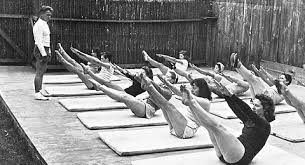 |
| Joseph Pilates teaching at Jacob's Pillow |
Pay attention to your scoop the next time you are in class and see how activating in this way deepens all of your exercises!
Wednesday, April 27, 2016


It's the Mind Itself Which Shapes the Body
It's the
mind itself
which
shapes
the body.
~ Joseph Pilates
~ Joseph Pilates

Sunday, April 24, 2016
Adding Essential Oils to Your Oil Pulling Routine
Essential oils have many uses. They can add a pleasing aroma, stimulate the senses or calm the senses, and aid in the well-being of the body. They can be taken internally, applied topically, and defused into the air. Below are just a few essential oils that you may consider adding to your oil pulling practice.
Oregano
Oregano oil is a "powerful antimicrobial that can help fight off infections. Oregano oil also has antibacterial, antiviral, and antifungal properties." Dr Mercola http://articles.mercola.com/herbal-oils/oregano-oil.aspx
Yesterday, I started to feel the slightest sore throat coming on, so I decided to add oregano oil to my coconut oil pulling regimen. I use my rounded tablespoon of coconut oil and add 5-8 drops of oregano oil into the spoonful of oil and then proceed as normal, holding, swishing, and pulling the oregano infused coconut oil in my mouth for 20 min. I am repeating this process 3-4 times/day as I am fighting off an infection.
Oregano oil can also be ingested. It has a strong burning quality to it so if it is too strong, you can add it to a carrier oil such as coconut oil, or we even use just a teaspoonful of cream or half & half to swallow it down. We often take 4 drops/day on a regular basis as a preventative. If you find that the oil bothers your stomach, try eating some food with it or you can also take it in a capsule by either adding a few drops to an empty capsule or buying it already encapsulated.

Frankinsense
 "Due to its antiseptic properties, frankincense oil is a great addition to any oral hygiene regimen.... It can help prevent dental health issues like tooth decay, bad breath, cavities, or oral infections. You can also consider making your own toothpaste by mixing frankincense oil with baking soda." Dr. Axe http://draxe.com/what-is-frankincense/

Lavender
"Lavender oil is known for its anti-inflammatory, antifungal, antidepressant, antiseptic, antibacterial, and antimicrobial properties. " Dr. Mercola http://articles.mercola.com/herbal-oils/lavender-oil.aspx
Tea Tree
 "Tea tree oil has been long valued for its antifungal, antibacterial, and antiviral properties. In the 1920s, it was used in dentistry and surgery to clean wounds and prevent infections." Dr. Mercola http://articles.mercola.com/herbal-oils/tea-tree-oil.aspx

Peppermint
Peppermint oil extract is shown to be more effective than the mouthwash chemical chlorhexidine in preventing the development of biofilm that contribute to cavities. It can also prevent bad breath. To use, just add one to two drops to your toothpaste. Dr Mercola http://articles.mercola.com/herbal-oils/peppermint-oil.aspx

Oregano
Oregano oil is a "powerful antimicrobial that can help fight off infections. Oregano oil also has antibacterial, antiviral, and antifungal properties." Dr Mercola http://articles.mercola.com/herbal-oils/oregano-oil.aspx
Yesterday, I started to feel the slightest sore throat coming on, so I decided to add oregano oil to my coconut oil pulling regimen. I use my rounded tablespoon of coconut oil and add 5-8 drops of oregano oil into the spoonful of oil and then proceed as normal, holding, swishing, and pulling the oregano infused coconut oil in my mouth for 20 min. I am repeating this process 3-4 times/day as I am fighting off an infection.
Oregano oil can also be ingested. It has a strong burning quality to it so if it is too strong, you can add it to a carrier oil such as coconut oil, or we even use just a teaspoonful of cream or half & half to swallow it down. We often take 4 drops/day on a regular basis as a preventative. If you find that the oil bothers your stomach, try eating some food with it or you can also take it in a capsule by either adding a few drops to an empty capsule or buying it already encapsulated.

Frankinsense


Lavender
"Lavender oil is known for its anti-inflammatory, antifungal, antidepressant, antiseptic, antibacterial, and antimicrobial properties. " Dr. Mercola http://articles.mercola.com/herbal-oils/lavender-oil.aspx
Tea Tree

Peppermint
Peppermint oil extract is shown to be more effective than the mouthwash chemical chlorhexidine in preventing the development of biofilm that contribute to cavities. It can also prevent bad breath. To use, just add one to two drops to your toothpaste. Dr Mercola http://articles.mercola.com/herbal-oils/peppermint-oil.aspx

Tuesday, April 19, 2016
"Nothing makes me feel like I'm back in my body more than Pilates."
Kate Hudson tells Self magazine,"...when she really wants to whip herself into shape, she focuses on Pilates. 'Nothing, literally nothing, makes me feel like I’m back to my body more than Pilates,' she says. 'I’ll travel, and I’ll go for a run or I’ll Spin. But when I go home and get on the Reformer or the Cadillac, my body immediately goes back. I can see an instant shift.' "


Subscribe to:
Posts (Atom)