
Monday, May 23, 2016
Good, Good, Good, Good Vibrations!
This is a vibrational universe - everything is energy, and we create by the vibration that we embody. Most of us do not create with intention, however. We simply observe "what is" and then offer back the same vibration of what we are observing. Upon first hearing this, one may say, "I can't possibly be the creator of my own life, for if I were, I would never choose 'this'!" However, vibration does not judge, it simply increases whatever it is focused on - wanted or unwanted. So if you want to create something new, something other than the "what is" that you are observing (a physical condition, financial condition, relationship, career - whatever!) you must withdraw your attention from the "what-isness" that you do not want and focus mentally and emotionally on what you do want until the dominant vibration within you regarding that subject is a vibrational match to what you do want. When you do this, the Universe must manifest your creation for you!


Series Work Within Classical Pilates
In classical Pilates, there are certain exercises that go together in groupings that are called, series. The series are designed so that the whole is worth more than the sum of their parts. On the Reformer these include, Footwork Series, Rowing Series, Stomach Massage Series, Long Box Series, Short Box Series, Long Stretch Series, Knee Stretch Series, and the Splits Series. On the Mat there is the Abdominal Series and the Side Kick Series. Each exercise in a series should flow seamlessly from one to the next so that the series feels like one continuous flowing movement. As an example, let's take a brief look at Footwork Series..
In both the Reformer and Mat workouts, the exercises start by lying on the back. This is to counter the force of gravity that is constantly pushing down on the body when it is upright. Lying on the back allows the spine to relax and lengthen, for the muscles to work with less tension, and the organs to settle into their places... and this is where we begin with Footwork Seris. Joseph Pilates put a lot of emphasis on the feet. It is important to have flexible, strong feet that propel and support the body properly when standing and in motion. In the Footwork Series we work the feet in different positions to strengthen and stretch the feet and ankles, and to lengthen and strengthen the legs, glutes, hips, and abdominals. During Footwork Series you want to flow without breaking from one repetition to the next, from one exercise to the next, keeping the Powerhouse engaged as you move out and in, and while changing from one position to the next. As you move from "Toes" to "Arches" to "Heels" to "Tendon Stretch" move the feet together, lifting them off of the foot bar together and placing them in the next position at the same time. Maintain the engagement of the Powerhouse and connections in the body rather than relaxing and walking the feet one at a time into the next position and then regathering all of your connections.
In both the Reformer and Mat workouts, the exercises start by lying on the back. This is to counter the force of gravity that is constantly pushing down on the body when it is upright. Lying on the back allows the spine to relax and lengthen, for the muscles to work with less tension, and the organs to settle into their places... and this is where we begin with Footwork Seris. Joseph Pilates put a lot of emphasis on the feet. It is important to have flexible, strong feet that propel and support the body properly when standing and in motion. In the Footwork Series we work the feet in different positions to strengthen and stretch the feet and ankles, and to lengthen and strengthen the legs, glutes, hips, and abdominals. During Footwork Series you want to flow without breaking from one repetition to the next, from one exercise to the next, keeping the Powerhouse engaged as you move out and in, and while changing from one position to the next. As you move from "Toes" to "Arches" to "Heels" to "Tendon Stretch" move the feet together, lifting them off of the foot bar together and placing them in the next position at the same time. Maintain the engagement of the Powerhouse and connections in the body rather than relaxing and walking the feet one at a time into the next position and then regathering all of your connections.
 |
| Joseph Pilates performing Footwork Series on the Reformer |
Saturday, May 21, 2016

Tuesday, May 17, 2016

Monday, May 16, 2016
The Three Critical Conections
In classical Pilates we talk about "Critical Connections" and you hear about them often from me in class :)
They include:
They include:
- The Three Anchors - referring to wrapping the inner thighs, drawing the sits bones in toward the centerline of the body, and scooping the low abdominals in and up.
- Ribs to Scapula and Scapula to Ribs Connection - meaning to draw the scapula, or shoulder blades, down the back of the body and pulling them in against the ribcage in the back while simultaneously pulling the front of the ribcage down the front of the body and pulling in towards the spine. Think of hugging
your shoulder blades against your ribs and your ribs against
 your shoulder blades.
- Heel to Seat Connection - the activation of lengthening the backs of your legs and reaching through your heels with your sits bones.

Put all of these together and what have you got...?
Pilates Stance!
Now that you are more aware of these connections, try focusing on them in the exercises and see how they deepen your practice.
Tuesday, May 10, 2016
Original "Cadillac"
 In 1912 Joseph Pilates was living in England and working as a boxer, circus performer, and self-defense instructor. When WWI broke out he was interned with other German nationals living in England. During this time he served as an orderly on the Isle of Man where he began modifying hospital beds so that those who were recovering from illness or injury could exercise.
Joseph Pilates designed all of the classical equipment that we still use today.
 |
| Reformer |
 |
| Wunda Chair |
 |
| Power Circle |
 |
| Ladder Barrel |
 |
| Guillotine |
 |
| Arm Chair (using the springs to strengthen the neck) |
… plus many, many more.
You Were Never Intended To Use Your Action To Make Things Happen
You create through thought,
you create through vibration.

You were never meant to use your action to make things happen, you were always intended to use your action to enjoy the benefit of what your energy alignment had actually accomplished.
~Abraham-Hicks
Monday, May 2, 2016
What Causes Muscle Cramps?
Is it dehydration? No
Is it electrolyte imbalance? No
Here is a quick video with Nobel Prize winner for chemistry, Dr. Roderick MacKinnon and new findings about what causes muscle cramps....
I will keep watching for when this information becomes public and let you know!
Is it electrolyte imbalance? No
Here is a quick video with Nobel Prize winner for chemistry, Dr. Roderick MacKinnon and new findings about what causes muscle cramps....
I will keep watching for when this information becomes public and let you know!
Integrity

If you need cooperation from others to feel good, you are in deep doo-doo. But when you only need cooperation from Self, when you only need the power to bring yourself into vibrational cooperation with who you are, isn't that truly what integrity is? Isn't integrity being a vibrational match to the true vibrational core that is you?
~ Abraham-Hicks
Weak Gluteus Medius with Danielle Ufniak (Physiotherapist)
This is a great short video which talks about the medial glute muscle and some indications that it may not be firing or activating correctly. There are many reasons why a body may begin to move into misalignments and when it does, some muscles no longer perform the way they should and other muscles try to compensate. If this continues, we often will experience pain.
Pilates exercises are designed to bring the body back into proper muscular and skeletal alignment. Learning how to activate the proper muscles during an exercise and attention to precision during your Pilates practice will help keep your body balanced, flexible, strong, and in alignment!
Pilates exercises are designed to bring the body back into proper muscular and skeletal alignment. Learning how to activate the proper muscles during an exercise and attention to precision during your Pilates practice will help keep your body balanced, flexible, strong, and in alignment!
Friday, April 29, 2016
What's the Scoop?
In Pilates we are always elongating the spine. We want to decompress the spine, countering the compression that gravity is constantly exerting on the spine, and lengthen, and strengthen the muscles that help the spine maintain its length and mobility. One of the main ways we do this is by activating what we call, our "scoop". In Pilates, we begin our sessions on our backs. One of the reasons for this is so we begin our work with our spines flat and supported (not working against gravity).
To find your scoop, lie on your back with your knees bent and your feet flat on the floor, hip width apart. Lengthen the back of the neck so that your head is resting more towards the bottom of the skull. Allow the collar bones to soften and the shoulders to fall back to the floor and down away from the neck and ears. Breathe down into your belly with soft natural breaths. On your next exhale, draw the front of your ribcage together and down the front of your body towards your waist. Continue breathing gently into the belly.
Now, pull your transverse abdominis muscle (the abdominal muscle that is between your navel and your pubic bone) back into your body towards your spine. Keep your tailbone down as you do this, do not allow your pelvis to curl. Activate and release this muscle a few times until you feel comfortable doing so. Now add the "scoop". Pull your transverse abdominis muscle back towards your spine and then draw your navel up under your ribcage while keeping your ribs pulled together and down. Again, do not let your pelvis tuck or curl during this movement. Feel how your waist and muscles around your spine lengthen.
Pay attention to your scoop the next time you are in class and see how activating in this way deepens all of your exercises!
To find your scoop, lie on your back with your knees bent and your feet flat on the floor, hip width apart. Lengthen the back of the neck so that your head is resting more towards the bottom of the skull. Allow the collar bones to soften and the shoulders to fall back to the floor and down away from the neck and ears. Breathe down into your belly with soft natural breaths. On your next exhale, draw the front of your ribcage together and down the front of your body towards your waist. Continue breathing gently into the belly.
Now, pull your transverse abdominis muscle (the abdominal muscle that is between your navel and your pubic bone) back into your body towards your spine. Keep your tailbone down as you do this, do not allow your pelvis to curl. Activate and release this muscle a few times until you feel comfortable doing so. Now add the "scoop". Pull your transverse abdominis muscle back towards your spine and then draw your navel up under your ribcage while keeping your ribs pulled together and down. Again, do not let your pelvis tuck or curl during this movement. Feel how your waist and muscles around your spine lengthen.
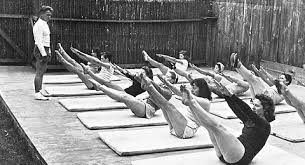 |
| Joseph Pilates teaching at Jacob's Pillow |
Pay attention to your scoop the next time you are in class and see how activating in this way deepens all of your exercises!
Wednesday, April 27, 2016


It's the Mind Itself Which Shapes the Body
It's the
mind itself
which
shapes
the body.
~ Joseph Pilates
~ Joseph Pilates

Sunday, April 24, 2016
Adding Essential Oils to Your Oil Pulling Routine
Essential oils have many uses. They can add a pleasing aroma, stimulate the senses or calm the senses, and aid in the well-being of the body. They can be taken internally, applied topically, and defused into the air. Below are just a few essential oils that you may consider adding to your oil pulling practice.
Oregano
Oregano oil is a "powerful antimicrobial that can help fight off infections. Oregano oil also has antibacterial, antiviral, and antifungal properties." Dr Mercola http://articles.mercola.com/herbal-oils/oregano-oil.aspx
Yesterday, I started to feel the slightest sore throat coming on, so I decided to add oregano oil to my coconut oil pulling regimen. I use my rounded tablespoon of coconut oil and add 5-8 drops of oregano oil into the spoonful of oil and then proceed as normal, holding, swishing, and pulling the oregano infused coconut oil in my mouth for 20 min. I am repeating this process 3-4 times/day as I am fighting off an infection.
Oregano oil can also be ingested. It has a strong burning quality to it so if it is too strong, you can add it to a carrier oil such as coconut oil, or we even use just a teaspoonful of cream or half & half to swallow it down. We often take 4 drops/day on a regular basis as a preventative. If you find that the oil bothers your stomach, try eating some food with it or you can also take it in a capsule by either adding a few drops to an empty capsule or buying it already encapsulated.

Frankinsense
 "Due to its antiseptic properties, frankincense oil is a great addition to any oral hygiene regimen.... It can help prevent dental health issues like tooth decay, bad breath, cavities, or oral infections. You can also consider making your own toothpaste by mixing frankincense oil with baking soda." Dr. Axe http://draxe.com/what-is-frankincense/

Lavender
"Lavender oil is known for its anti-inflammatory, antifungal, antidepressant, antiseptic, antibacterial, and antimicrobial properties. " Dr. Mercola http://articles.mercola.com/herbal-oils/lavender-oil.aspx
Tea Tree
 "Tea tree oil has been long valued for its antifungal, antibacterial, and antiviral properties. In the 1920s, it was used in dentistry and surgery to clean wounds and prevent infections." Dr. Mercola http://articles.mercola.com/herbal-oils/tea-tree-oil.aspx

Peppermint
Peppermint oil extract is shown to be more effective than the mouthwash chemical chlorhexidine in preventing the development of biofilm that contribute to cavities. It can also prevent bad breath. To use, just add one to two drops to your toothpaste. Dr Mercola http://articles.mercola.com/herbal-oils/peppermint-oil.aspx

Oregano
Oregano oil is a "powerful antimicrobial that can help fight off infections. Oregano oil also has antibacterial, antiviral, and antifungal properties." Dr Mercola http://articles.mercola.com/herbal-oils/oregano-oil.aspx
Yesterday, I started to feel the slightest sore throat coming on, so I decided to add oregano oil to my coconut oil pulling regimen. I use my rounded tablespoon of coconut oil and add 5-8 drops of oregano oil into the spoonful of oil and then proceed as normal, holding, swishing, and pulling the oregano infused coconut oil in my mouth for 20 min. I am repeating this process 3-4 times/day as I am fighting off an infection.
Oregano oil can also be ingested. It has a strong burning quality to it so if it is too strong, you can add it to a carrier oil such as coconut oil, or we even use just a teaspoonful of cream or half & half to swallow it down. We often take 4 drops/day on a regular basis as a preventative. If you find that the oil bothers your stomach, try eating some food with it or you can also take it in a capsule by either adding a few drops to an empty capsule or buying it already encapsulated.

Frankinsense


Lavender
"Lavender oil is known for its anti-inflammatory, antifungal, antidepressant, antiseptic, antibacterial, and antimicrobial properties. " Dr. Mercola http://articles.mercola.com/herbal-oils/lavender-oil.aspx
Tea Tree

Peppermint
Peppermint oil extract is shown to be more effective than the mouthwash chemical chlorhexidine in preventing the development of biofilm that contribute to cavities. It can also prevent bad breath. To use, just add one to two drops to your toothpaste. Dr Mercola http://articles.mercola.com/herbal-oils/peppermint-oil.aspx

Tuesday, April 19, 2016
"Nothing makes me feel like I'm back in my body more than Pilates."
Kate Hudson tells Self magazine,"...when she really wants to whip herself into shape, she focuses on Pilates. 'Nothing, literally nothing, makes me feel like I’m back to my body more than Pilates,' she says. 'I’ll travel, and I’ll go for a run or I’ll Spin. But when I go home and get on the Reformer or the Cadillac, my body immediately goes back. I can see an instant shift.' "


Sunday, April 17, 2016
Oil Pulling
I love oil pulling!

I discovered oil pulling a few months ago and I do it almost every day without fail. I keep a jar of organic cold processed unrefined coconut oil in my bathroom and a tablespoon, and "pull" for 20 min while I shower and dry off. (FYI, one time I accidentally bought "processed" coconut oil and the feel in the mouth and the taste were horrible! I couldn't use it.)
To oil pull you will take enough oil to give a full feeling in the mouth, but not so full as to feel that you can't hold it for long. For me, this is a rounded tablespoon. Less than a tablespoon feels like I begin to have more saliva than oil and it can be hard to swish, and more than a tablespoon feels like I can't hold it for the full 20 min. During the warmer months, if the oil becomes liquified, you can either refrigerate it or you can just "drink" it out of the jar.
Take the oil into your mouth and within a few seconds it will melt. Begin to swish it in your mouth and "pulling" it between your teeth. When you first begin oil pulling, you may develop a lot of saliva or the muscles in your mouth may feel like they can't swish for a full 20 min. Just go for as long as you can, spit it out and start over with a fresh spoonful. Soon your mouth will not produce so much saliva and your muscles will quickly adapt to the regimen.
When you spit the oil out, spit it into a container and then throw it in your trash (we usually have an empty bag such as a frozen fruit bag or chip bag that I use). You don't want to spit down the sink or into the toilet as the oil will begin to congeal in your pipes.
After pulling, rinse your mouth and spit. (I give my teeth a quick light brush before pulling, but other places will tell you to brush after pulling).
My experience with oil pulling is that my mouth feels fresher and cleaner than I can get with brushing and flossing. I feel as if my gums, tongue, and inside of my mouth have been cleaned and moisturized (I have used tongue cleaners before but oil pulling feels even cleaner). Even my throat and lips feel moisturized.
I have receding gums and deep pockets around my molars and about once every year or two, I will develop an abscess in one of these pockets. If you have ever experienced a tooth infection, you know how painful this can be. In the past I have gone to the dentist to get the pocket cleaned or have treated it at home with Tea Tree oil. The abscess usually takes about a week to run its course and I have a lot of pain. Shortly after beginning oil pulling, I developed an abscess. I continued to oil pull and within two days it was gone and I had almost no pain.
Oil pulling has become a favorite part of my morning routine.
Here is a link to an article and a video by Dr. Draxe with more information about oil pulling.
http://draxe.com/oil-pulling-coconut-oil/

I discovered oil pulling a few months ago and I do it almost every day without fail. I keep a jar of organic cold processed unrefined coconut oil in my bathroom and a tablespoon, and "pull" for 20 min while I shower and dry off. (FYI, one time I accidentally bought "processed" coconut oil and the feel in the mouth and the taste were horrible! I couldn't use it.)
To oil pull you will take enough oil to give a full feeling in the mouth, but not so full as to feel that you can't hold it for long. For me, this is a rounded tablespoon. Less than a tablespoon feels like I begin to have more saliva than oil and it can be hard to swish, and more than a tablespoon feels like I can't hold it for the full 20 min. During the warmer months, if the oil becomes liquified, you can either refrigerate it or you can just "drink" it out of the jar.
Take the oil into your mouth and within a few seconds it will melt. Begin to swish it in your mouth and "pulling" it between your teeth. When you first begin oil pulling, you may develop a lot of saliva or the muscles in your mouth may feel like they can't swish for a full 20 min. Just go for as long as you can, spit it out and start over with a fresh spoonful. Soon your mouth will not produce so much saliva and your muscles will quickly adapt to the regimen.
When you spit the oil out, spit it into a container and then throw it in your trash (we usually have an empty bag such as a frozen fruit bag or chip bag that I use). You don't want to spit down the sink or into the toilet as the oil will begin to congeal in your pipes.
After pulling, rinse your mouth and spit. (I give my teeth a quick light brush before pulling, but other places will tell you to brush after pulling).
My experience with oil pulling is that my mouth feels fresher and cleaner than I can get with brushing and flossing. I feel as if my gums, tongue, and inside of my mouth have been cleaned and moisturized (I have used tongue cleaners before but oil pulling feels even cleaner). Even my throat and lips feel moisturized.
I have receding gums and deep pockets around my molars and about once every year or two, I will develop an abscess in one of these pockets. If you have ever experienced a tooth infection, you know how painful this can be. In the past I have gone to the dentist to get the pocket cleaned or have treated it at home with Tea Tree oil. The abscess usually takes about a week to run its course and I have a lot of pain. Shortly after beginning oil pulling, I developed an abscess. I continued to oil pull and within two days it was gone and I had almost no pain.
Oil pulling has become a favorite part of my morning routine.
Here is a link to an article and a video by Dr. Draxe with more information about oil pulling.
http://draxe.com/oil-pulling-coconut-oil/
Saturday, April 16, 2016
Get Your Wrap On
In Pilates we talk a lot about "engaging your wrap", but what does this mean?
Remember, we are always working with the body in proper skeletal alignment and then activating, strengthening, and balancing the muscles that help hold this alignment. To wrap means to bring the legs into a slight turn out (approximately big enough to fit your fist between the knuckles of your big toes) by engaging the rotator muscles where the upper leg connects with the pelvis, the glutes, and the muscles of the pelvic floor. It should feel as if you are trying to draw your sits bones together and you should be able to feel a stabilization of the hip girdle and muscle activation where the backs of the thighs meet the glutes. Do not clench or squeeze the glutes. Now, l-e-n-g-t-h-e-n your inner thighs, reaching your heels as far from your hips as you can while pressing your heels together. As you engage your wrap, you should notice that your quads and hip-flexors can now release their gripping tension that is so common when we attempt to engage our legs.
Remember, we are always working with the body in proper skeletal alignment and then activating, strengthening, and balancing the muscles that help hold this alignment. To wrap means to bring the legs into a slight turn out (approximately big enough to fit your fist between the knuckles of your big toes) by engaging the rotator muscles where the upper leg connects with the pelvis, the glutes, and the muscles of the pelvic floor. It should feel as if you are trying to draw your sits bones together and you should be able to feel a stabilization of the hip girdle and muscle activation where the backs of the thighs meet the glutes. Do not clench or squeeze the glutes. Now, l-e-n-g-t-h-e-n your inner thighs, reaching your heels as far from your hips as you can while pressing your heels together. As you engage your wrap, you should notice that your quads and hip-flexors can now release their gripping tension that is so common when we attempt to engage our legs.
 |
| Joseph Pilates |
Thursday, April 14, 2016
Level 3 Mat
Whew! This was a tough one. I kept having video problems and wouldn't know it until I had finished the full routine. Had to film this one 3 times back to back to finally get a good video.
Now your turn. Do this workout 3 time quickly :))
Now your turn. Do this workout 3 time quickly :))
Subscribe to:
Posts (Atom)